


Please Leave Us A Message
Privacy statement: Your privacy is very important to Us. Our company promises not to disclose your personal information to any external company with out your explicit permission.
 Yongkang Ruixiang Metal Products Co., Ltd.
Choosing between 304 and 201 stainless is the single most consequential decision in a kitchen metalware order, because the grade sets the tool's service life, its food-safety status, and your resale risk. The two look identical on a shelf, yet their chemistry diverges sharply: 304 carries roughly 8 percent nickel that stabilizes the rust-resistant oxide film, while 201 replaces most of that nickel with manganese and costs 30–50 percent less. A Stainless Steel Fruit Basket in 304 will keep its polish through years of buffet cycles, whereas a 201 version can develop rust blooms in a humid display within a single season. Ruixiang Metal recommends specifying verified 304 for any item that contacts food, and discloses grade transparently rather than letting a lower-cost substitute slip into a shipment.
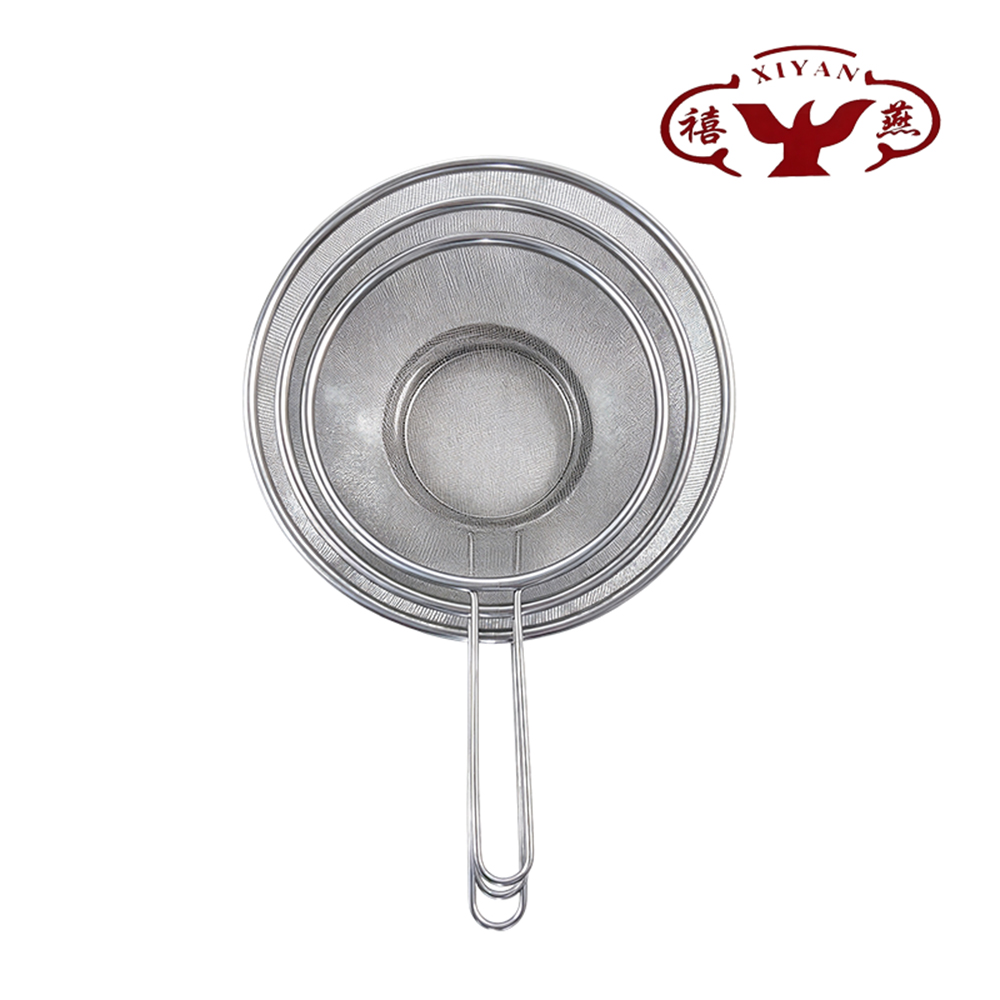
For anything touching hot fat or acidic food, the grade choice is non-negotiable, because low-nickel steel corrodes quickly and can shed metallic particles into what you are cooking. In salt-spray testing, 304 resists corrosion for 48–96 hours before any sign of attack, while 201 typically shows rust within 24 hours. A Cooking Oil Strainer sees exactly the hostile mix that punishes weak steel — high temperature, food acids, and chlorinated detergents during cleanup — so a 201 mesh seat can pit and weaken after a handful of services. Yongkang Ruixiang Metal Products Co., Ltd. supplies material declarations and can reference 304's compliance with FDA, LFGB, or NSF/ANSI 51 so importers meet their market's food-contact rules.
| Property | 304 (18/8) | 201 (Mn-substituted) |
| Nickel content | 8%+ | ~1% |
| Salt-spray resistance | 48–96 h | <24 h |
| Food-contact status | Food-grade | Not food-grade |
| Relative cost | Baseline | 30–50% lower |
The 201 grade is not "toxic" in the sense of immediate harm, but it is not a food-contact material under recognized standards, and its lower corrosion resistance means higher long-term replacement cost. For dry, neutral, hand-washed home use it can perform acceptably; for commercial dishwashers and acidic prep it fails early. Buyers should require a Mill Test Certificate confirming chromium at or above 18 percent and nickel at or above 8 percent, and commission XRF spot checks on random units for large programs.
For buyers serving multiple markets, the documentation trail matters as much as the steel. A Mill Test Certificate that names the exact heat number lets you trace a complaint back to a specific batch, and it satisfies auditors who will not accept a generic food-grade claim. Keep the certificate with the shipment paperwork rather than in a separate file.
✅ Bottom line: Use 304 for any hot-oil or acidic-contact item; reserve 201 for disclosed, low-risk dry applications only.
Wash and prep tools face a different but related test — constant wetness, acidity from produce, and impact — that exposes weak steel within months rather than years. A Draining Basket used to rinse rice and vegetables sits wet, picks up vinegar-based washes, and gets dropped into sinks, so a 201 bowl flexes, dents, and rusts at the weld seams long before a 304 unit shows wear. Ruixiang Metal builds these in 304 with rolled, de-burred rims and reinforced welds, which is why the pieces survive central-kitchen throughput instead of being replaced each quarter.
From a total-cost view, the 30–50 percent saving on 201 steel is usually erased by replacement labor, customer complaints, and returns within the first two years of commercial use. Specifying 304 also de-risks your own brand: a single food-safety incident traced to non-compliant metal can cost far more than the steel premium across an entire product line. For coastal or high-humidity markets, step up to 316 with its added molybdenum, though most programs are well served by documented 304.
Impact testing is a low-cost check buyers skip too often. Drop a filled bowl from counter height onto a concrete floor a few times during sampling; a 304 unit with a welded base shrugs it off, while a folded or 201 unit shows a seam crack immediately. That thirty-second test predicts a year of kitchen abuse better than any spec sheet. Sourcing directly from a China factory that holds tooling for both grades lets a brand change specification without re-qualifying a new supplier.
✅ Bottom line: Prep tools age fastest in wet, acidic use; 304's durability and compliance beat 201's upfront discount on lifetime cost.
Q: Can I tell 304 from 201 just by looking? A: Not reliably — both can appear bright and similar. The trustworthy methods are a Mill Test Certificate from the mill, XRF elemental analysis on a sample, or a lab chemical test. Ruixiang Metal provides batch MTCs so importers are not judging by eye alone.
Q: Is 201 ever acceptable for a kitchen brand? A: Only for disclosed, dry, low-risk applications where food contact is minimal and hand washing is the norm. For any commercial or food-contact program, 304 is the responsible specification, and Ruixiang Metal will flag the trade-off before production.
Q: Why does 304 cost more, and is it worth it? A: Nickel trades at a premium globally, and 304 carries roughly double the nickel of 201, which translates to a 15–30 percent finished-price gap at equal gauge. For lifespan, compliance, and brand safety, that premium pays back within the first replacement cycle.
Ruixiang Metal is a direct OEM/ODM custom kitchenware manufacturer in Yongkang, offering wholesale verified-304 ranges with batch-level material documentation and flexible MOQs for global importers. Tell us your target market's compliance framework and we will spec, sample, and quote a grade-appropriate range — request a material declaration with your next inquiry.
Mobile: +86 13868957824
Email: ruixiangmetal@qq.com
Website: www.ykruixiang.com
Email to this supplier
Privacy statement: Your privacy is very important to Us. Our company promises not to disclose your personal information to any external company with out your explicit permission.
Fill in more information so that we can get in touch with you faster
Privacy statement: Your privacy is very important to Us. Our company promises not to disclose your personal information to any external company with out your explicit permission.